

The Difference Between a Zoho Setup and a Real Business System

08.10.2026 07:01 AM

The Difference Between a Zoho Setup and a Real Business System

You've probably heard that Zoho One is the operating system for business. It's a compelling promise that suggests you can simply log in, flip a few switches, and watch your chaos dissolve into a world of automated efficiency. Most founders jump into the platform with this exact expectation: they buy the license, they turn on the CRM, and they start moving their data.

It's a logical starting point, but it's often where the trouble begins. Implementation isn't the same thing as architecture. While anyone with a credit card can set up an account, very few people actually build a system that supports the way their business breathes.

There's a specific, quiet frustration that happens a few months after a basic setup. You realize that while you have the tools, you're still spending your mornings jumping between tabs. You're still manually copy-pasting names from an email into a project management board. The "integrated" dream starts to feel like a collection of expensive digital silos that just happen to share the same login credentials.

The Myth of the Simple Setup

Buying software is a transaction, but building a business system is a design project. When most people talk about a Zoho setup, they're referring to configuration. This involves choosing a theme, importing a contact list, and maybe setting up a single automated email. They're all useful tasks, but they're tactical. They focus on what the software can do rather than what your business needs to accomplish.

Configuration is about the "how" of the tool. Architecture is about the "why" of the operation. If you start with the tool before you've designed the flow, you're essentially picking out the wallpaper for a house that hasn't been framed yet. You'll end up with a beautiful CRM that doesn't actually talk to your finance app, or a desk full of leads that your delivery team can't even see.


This inside-out design approach is non-negotiable. It's how we ensure that the final system replaces those manual workarounds instead of just digitizing them. We're not looking to overengineer your business. We're looking to create clarity and reduce the mental load that comes with managing disconnected tools.

Why Implementation Alone Leads to Drag
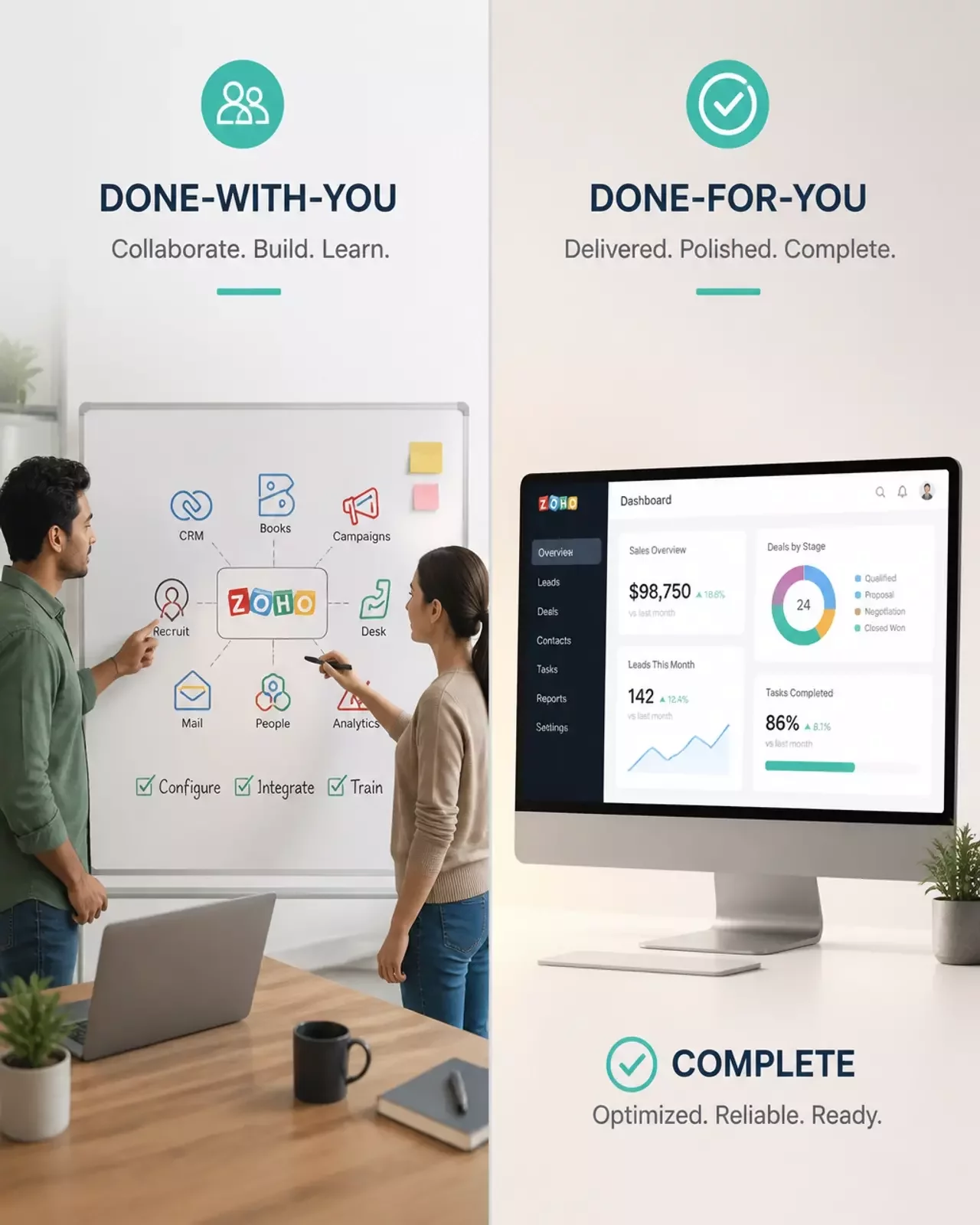
When you focus only on implementation, you're usually solving for a single moment in time. You need a way to track leads, so you turn on Zoho CRM. Later, you need to send invoices, so you turn on Zoho Books. Because these steps were taken in isolation, they often lack a connective tissue. This is how operational drag is born.

Drag is the invisible tax you pay every time a process requires a manual workaround. It's the ten minutes spent checking if a payment went through before you start a project. It's the "quick" Slack message to ask a team member for a status update because the system doesn't show it. These moments feel small, but they accumulate. Over a year, they represent hundreds of hours of lost focus and mental energy.

A true business system is designed to eliminate this friction. It assumes that every action in one app should trigger a reaction in another. When a deal is won, the project should be created automatically. When a task is completed, the client should receive an update without you lifting a finger. This level of connectivity doesn't come from a standard setup: it comes from intentional architecture.

The Role of the Operational Architect

There's a reason we don't call ourselves software configurators. An Operational Architect is someone who understands the plumbing of a business. We don't just look at the apps; we look at the logic. We're the ones who ask what happens if a client cancels, or how a specific piece of data needs to be reported three months from now.

Most consultants will ask you which apps you want to use. We start by asking how your business actually runs. We want to know where the bottlenecks are and which manual tasks are keeping you awake at night. Our goal is to build a structure that serves the human beings in the company, not the other way around.

This is the core of our approach at Unparalleled MRS. We focus on building clean, connected systems that reduce your mental load. Whether you're a solo founder looking for a structured, expert-led path to build your own setup or a growing team that needs a custom, automated build, the priority is always the architecture.

Choosing Your Level of Support

Not every business needs a multi-app custom automation from day one. Some founders are just starting to feel the weight of their tools and need a solid foundation. Others have reached a level of complexity where a standard setup is no longer enough.

For the DIY-minded founder, our Unparalleled Foundation service offers a way to build a professional-grade system without the guesswork. It's about getting the architecture right from the start so you don't have to tear it all down later. It's a quarter-long commitment to learning the right way to use Zoho One.

Teams with more moving parts often benefit from our Unparalleled System offer. This is a done-for-you build that focuses on the core apps like CRM, Books, and Projects. We handle the heavy configuration while keeping you in the loop, ensuring that the final product is something your team will actually use.

If your business has unique workflows or complex data requirements, our Unparalleled Custom build is the answer. This is where we dive deep into advanced automation and multi-app integrations. It's for the founder who's done building in pieces and wants a truly unified operating environment.

The Freedom of Ownership

One of the biggest differences between a typical implementation and our approach is the focus on independence. Many consultants build systems that are so complex they require a retainer just to keep them running. We find that frustrating and counterproductive.


Our goal is to reduce your dependency on us. By the time we finish a project, you should feel like the owner of your system, not a guest in it. We want you to understand the logic behind the workflows so you can make adjustments as your business evolves. A system that serves the founder is one that can be managed by the founder.


When you have a real business system, your relationship with your work changes. You stop feeling like you're constantly catching up. You open your laptop in the morning and see exactly what needs your attention. There's a profound sense of operational calm that comes from knowing your backend is handled.

Stop Tinkering and Start Designing

If you've been clicking around in Zoho and feeling like you're missing the "secret sauce," you're probably just missing the architecture. It's not your fault that the tools feel disconnected: they were sold to you as individual solutions, not a unified system.


The shift from being a "user" of software to an "owner" of a system is the most important transition a growing business can make. It's the difference between a business that stays small because it's limited by its founder's bandwidth and a business that can scale because its structure is sound.

Is your backend holding you back?

If you're tired of being the only thing holding your apps together, let's look at your architecture. Whether you want to build it yourself with our guidance or have us handle the design, we'll help you find the operational clarity you've been looking for. Explore our service options to see which path is right for your next level of growth.